
As your business grows, your IT setup needs to grow with it. For small teams, it can be difficult to handle escalating IT challenges with limited time and resources, and you’ll need external support.
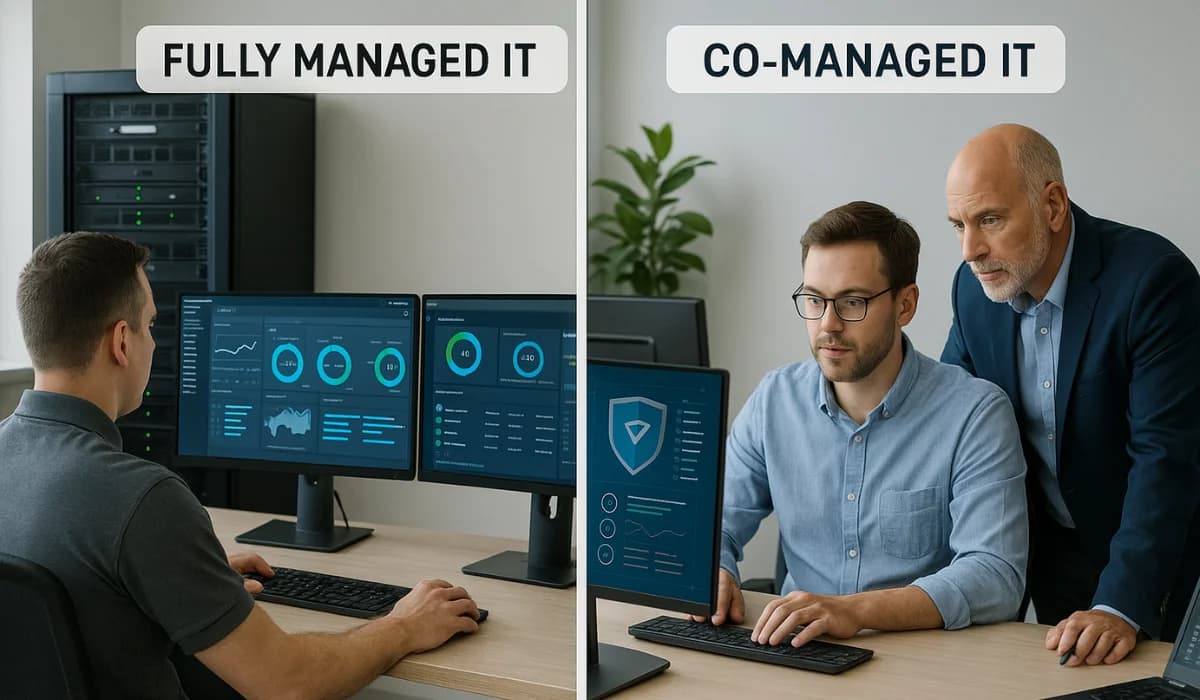
When bringing on a third-party IT partner, you have two primary models to choose from: fully managed or co-managed IT services. Both forms of IT support have their pros and cons, so you’ll need to choose the one that makes the most sense for your business needs. In this article, we’ll break down the difference between these two IT service models to help you decide which one is right for you.
Key takeaways
- Working with a managed IT services provider can help you operate more efficiently, keep your systems safer, and save money.
- With fully managed IT services, your MSP handles all your IT responsibilities, serving as an outsourced version of your entire IT department.
- With co-managed IT services, your MSP has shared responsibility with your in-house IT team.
- Fully managed IT services are great for teams that want straightforward, comprehensive IT support, while co-managed IT services are better for those who prefer a collaborative approach.
Understanding fully managed IT services
With fully managed IT services, you outsource your entire IT environment to a Managed Service Provider (MSP). The MSP takes responsibility for all of your IT infrastructure and day-to-day operations, functioning as a complete alternative to an in-house IT department.
What’s included
While exact service packages vary by provider, here’s what’s usually included in fully managed IT services:
- 24/7 system monitoring and help desk support
- Network management
- Cybersecurity services, including firewall configuration, endpoint protection, advanced threat detection, and vulnerability management
- Regular data backups and disaster recovery services
- Software patching and updates
- Cloud services
- Vendor management
- Strategic IT consulting and roadmapping
Pros of fully managed IT services
Here are some of the advantages of a fully-managed IT service arrangement:
- Comprehensive coverage: You get peace of mind knowing that your MSP is handling all your IT needs from start to finish. This way, your internal team can focus on your core business, rather than putting out technical fires.
- Predictable costs: With fully managed IT services, you’ll pay a flat monthly fee with no surprise expenses, making it easy to budget.
- Access to a wide range of expertise: You’ll get access to an IT team with specialized skills and years of experience, without the high price tag of hiring them full-time. The average salary for an IT manager in the US is $103,125 per year, and can be even higher for professionals with extensive expertise.
- Proactive, strategic approach: Your MSP will get to know your business goals and needs and will take proactive steps to prevent threats and keep everything operating efficiently.
- Enhanced security posture: MSPs have access to industry-leading cybersecurity tools, which they will use to fortify your systems against external threats.
Cons of fully managed IT services
While fully managed IT services have plenty of benefits, they also come with some downsides, which include:
- Less direct control: You’ll be turning over your entire IT strategy to your MSP, which means you’ll have less control over day-to-day decision making than you might like.
- IT dependency: You’ll be depending entirely on your MSP to handle your systems. This can cause problems if your MSP is unavailable at any point or if they encounter any performance issues.
Who is it for?
Fully managed IT services are best for small businesses that don’t have any in-house IT staff. With a fully-managed approach, you’ll get the levels of cybersecurity and uptime you need, without the need to hire full-time experts.
This approach is also great for businesses that have straightforward IT needs and prefer hands-off IT support. You’ll get the consistency and predictability you need, so you can focus entirely on running your business. If you’re one of the 60% of small businesses that do not have a cybersecurity strategy at all, fully managed IT may be the most effective way to build one.
Understanding co-managed IT services
Co-managed services, or hybrid IT, is a collaborative approach where an external MSP partners with your in-house IT team. Your MSP supports your internal IT team by addressing specific needs and handling tasks you don’t have time for. Both parties share responsibility for your IT operations, rather than outsourcing everything.
What’s included
- Help desk overflow: Your MSP handles after-hours or vacation coverage to ensure 24/7 availability.
- Specialized expertise: The MSP provides external expertise to balance the skills you already have in-house. For example, they can provide extra support for advanced cybersecurity solutions or complex cloud migrations.
- Tooling and monitoring: Your MSP provides access to enterprise-grade tools and other IT solutions you don’t have in-house.
- Documentation & best practices: An MSP can help with technical documentation, compliance, and cybersecurity best practices, adding extra structure to your operations.
- Strategic planning: Your MSP can partner with your internal IT team to build a custom IT and cybersecurity strategy.
Pros of co-managed IT services
Here are some of the advantages of using co-managed IT services for your business:
- Leverage existing talent: With a co-managed approach, you’ll continue to maximize your in-house staff’s capabilities and use the MSP for additional support, rather than outsourcing completely.
- Fill skill gaps: No matter how great your internal IT staff is, you’ll occasionally encounter skill gaps. With co-managed IT, you get access to the expertise you need, without the high costs of a full-time hire.
- Reduce employee burnout: You can offload routine, time-consuming tasks to prevent your in-house staff from getting overworked.
- Increased control: While your MSP will be providing valuable support, you’ll be in full control of the decision-making.
- Cost-effective scalability: Co-managed IT is priced reasonably, so you can grow your operations without IT costs ballooning. You’ll only pay for the services you use, and you can adjust your service plan based on your budget.
Cons of co-managed IT services
Before committing to co-managed IT services, you should be aware of the downsides of this approach, which include:
- Requires frequent communication: You’ll need to stay in close contact with your MSP to prevent confusion, which can be time-consuming.
- Roles can blur: If you don’t clearly define each person’s role at the beginning of the partnership, it could lead to confusion or conflict later on.
- Need capable internal IT staff: Even with a great managed IT services provider, you could struggle if your in-house staff doesn’t have any IT expertise.
Who is it for?
Co-managed IT services are great for medium-sized businesses that already have some IT staff, but frequently find themselves stretched thin. It’s also a good choice for businesses that want to maintain control over their IT systems but need external support to solve specific problems.
Key differentiators: At a glance
Fully-managed and co-managed IT plans offer similar services, but there are several key differences between the two options. Here’s a direct comparison between these two IT models.
| Feature/Aspect | Fully Managed IT | Co-Managed IT |
|---|---|---|
| Control Level | Low (MSP handles everything) | High (Internal team retains key control) |
| Internal IT Staff | Not required (or very minimal) | Required (MSP augments existing team) |
| Scope of Services | Comprehensive, all-encompassing | Targeted, fills specific gaps, complements existing |
| Cost Structure | Typically predictable, all-inclusive monthly fee | More variable, based on specific services rendered |
| Responsibility | MSP takes full accountability | Shared responsibility, collaborative |
| Scalability | Easily scale up/down with business needs | Scales specific IT functions or expertise |
| Ideal For | Small businesses, no IT staff, hands-off approach | Growing businesses, existing IT staff, and specific needs |
Factors to consider when making your choice
Before deciding what type of IT partnership you need for your business, there are several questions to ask and factors to consider. Here’s what to consider when making an informed decision.
- Current IT staffing and expertise: Do you already have a dedicated IT department? If so, do they have the skills and bandwidth to meet your current challenges? Businesses without an IT department may prefer a fully-managed approach, while businesses that do have an IT department may prefer co-managed IT.
- Business growth: How fast is your business growing? What type of IT functions and technology infrastructure will you need as your business scales?
- Budget and financial goals: Do you prefer fixed monthly costs, or can your budget accommodate variable fees based on the services used each month? How many internal IT specialists can you afford to maintain?
- Regulatory compliance and security needs: Does your industry have strict technical compliance requirements? Do you struggle to defend your systems from external cybersecurity threats?
- Strategic initiatives: Do you need help developing a long-term IT strategy, or would you prefer your in-house IT team to handle your strategy? With fully managed IT services, your MSP will handle strategy, but with co-managed IT services, your team will be the one driving your strategy forward.
Finding your ideal IT partnership with Tech Advisors
At Tech Advisors, we offer both fully-managed and co-managed IT services for our clients. We don’t believe in one-size-fits-all solutions; instead, we work with your team to develop a plan that’s right for your needs.
We can act as your complete outsourced IT department, or integrate with your existing IT team: the choice is yours. Contact Tech Advisors today for a free consultation. We’ll help you decide which model is best for your needs.